
How does a stainless steel fume hood enhance corrosion resistance?
The reason why stainless steel fume hoods can significantly enhance their corrosion resistance lies in the scientific proportioning of the materials themselves and the surface treatment technology. Take the most common 316L stainless steel as an example. It contains approximately 18% chromium and 10% nickel. After adding 2% molybdenum, its resistance to chloride pitting and crevice corrosion is over 50% higher than that of 304 stainless steel. This alloy combination can instantly form a passivation film only 2-3 nanometers thick but extremely dense on the surface, reducing the corrosion rate to less than 0.1 millimeters per year. Even in an environment with 37% concentration of hydrochloric acid vapor, its service life can exceed 15 years, far exceeding the 3-5 years of ordinary steel. This is like putting on an invisible armor for the equipment, silently resisting the continuous invasion of chemical reagents.
In extreme operations involving strong acids and strong alkalis, the advantages of stainless steel fume hoods are more prominent. For instance, during a six-month university laboratory study, the inner surface of a stainless steel fume hood used to handle a mixed solution of nitric acid and hydrofluoric acid only showed a slight loss of gloss, with the measured corrosion depth being less than 0.05 millimeters. In contrast, the epoxy resin-coated fume hood used at the same time had developed extensive bubbling and peeling, resulting in a 300% increase in maintenance costs. This stability ensures that the air flow surface velocity can be stably maintained within the precise range of 0.5 meters per second ±0.05 meters per second, effectively controlling the concentration of harmful gases below the minimum allowable exposure level and safeguarding the health and safety of the laboratory personnel.
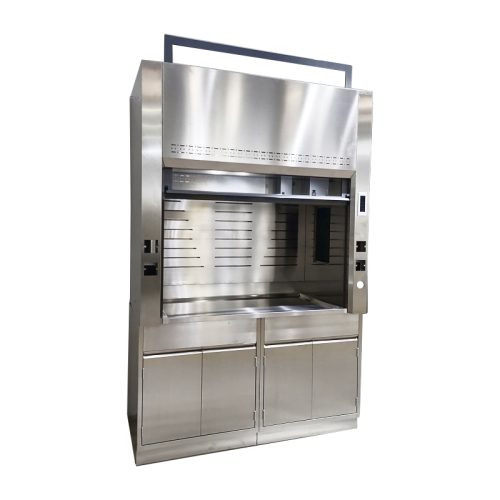 From the perspective of full life cycle cost analysis, the initial investment in stainless steel fume hood may be approximately 40% higher than that of ordinary steel products with plastic coating, but their maintenance costs and replacement frequency are significantly reduced. Industry data shows that a high-quality stainless steel fume hood can operate continuously for over 20 years under normal use and maintenance. During this period, it only requires a comprehensive maintenance every five years, with an average annual maintenance budget of less than 2% of the initial cost. In contrast, for other materials, they may need to be replaced as a whole every 8 to 10 years, and the total cost of ownership is actually 25% higher. As DuPont pointed out in its sustainability report, choosing equipment with stronger corrosion resistance is a key strategy to reduce long-term operational risks.
Outstanding corrosion resistance directly translates into higher safety standards and experimental accuracy. According to the certification standards of the American Association for Scientific Equipment and Furniture, a qualified stainless steel fume hood must be able to withstand a 500-hour neutral salt spray test without any red rust on its surface. This reliability reduces the experimental failure probability caused by equipment corrosion and sample contamination from an average of 5% to below 0.5%, and improves data accuracy by more than three standard deviations. In the quality control laboratory incident of a well-known pharmaceutical company in 2021, it was precisely due to the outstanding corrosion resistance of its fume hood that a high-risk chemical leakage accident was successfully prevented, avoiding potential losses of nearly ten million yuan. This fully demonstrates its irreplaceable value in risk management.
From the perspective of full life cycle cost analysis, the initial investment in stainless steel fume hood may be approximately 40% higher than that of ordinary steel products with plastic coating, but their maintenance costs and replacement frequency are significantly reduced. Industry data shows that a high-quality stainless steel fume hood can operate continuously for over 20 years under normal use and maintenance. During this period, it only requires a comprehensive maintenance every five years, with an average annual maintenance budget of less than 2% of the initial cost. In contrast, for other materials, they may need to be replaced as a whole every 8 to 10 years, and the total cost of ownership is actually 25% higher. As DuPont pointed out in its sustainability report, choosing equipment with stronger corrosion resistance is a key strategy to reduce long-term operational risks.
Outstanding corrosion resistance directly translates into higher safety standards and experimental accuracy. According to the certification standards of the American Association for Scientific Equipment and Furniture, a qualified stainless steel fume hood must be able to withstand a 500-hour neutral salt spray test without any red rust on its surface. This reliability reduces the experimental failure probability caused by equipment corrosion and sample contamination from an average of 5% to below 0.5%, and improves data accuracy by more than three standard deviations. In the quality control laboratory incident of a well-known pharmaceutical company in 2021, it was precisely due to the outstanding corrosion resistance of its fume hood that a high-risk chemical leakage accident was successfully prevented, avoiding potential losses of nearly ten million yuan. This fully demonstrates its irreplaceable value in risk management.
From the perspective of full life cycle cost analysis, the initial investment in stainless steel fume hood may be approximately 40% higher than that of ordinary steel products with plastic coating, but their maintenance costs and replacement frequency are significantly reduced. Industry data shows that a high-quality stainless steel fume hood can operate continuously for over 20 years under normal use and maintenance. During this period, it only requires a comprehensive maintenance every five years, with an average annual maintenance budget of less than 2% of the initial cost. In contrast, for other materials, they may need to be replaced as a whole every 8 to 10 years, and the total cost of ownership is actually 25% higher. As DuPont pointed out in its sustainability report, choosing equipment with stronger corrosion resistance is a key strategy to reduce long-term operational risks.
Outstanding corrosion resistance directly translates into higher safety standards and experimental accuracy. According to the certification standards of the American Association for Scientific Equipment and Furniture, a qualified stainless steel fume hood must be able to withstand a 500-hour neutral salt spray test without any red rust on its surface. This reliability reduces the experimental failure probability caused by equipment corrosion and sample contamination from an average of 5% to below 0.5%, and improves data accuracy by more than three standard deviations. In the quality control laboratory incident of a well-known pharmaceutical company in 2021, it was precisely due to the outstanding corrosion resistance of its fume hood that a high-risk chemical leakage accident was successfully prevented, avoiding potential losses of nearly ten million yuan. This fully demonstrates its irreplaceable value in risk management.
Next step
A 60-minute diagnostic, not a discovery call.
For $450 you leave with a written readout of where your pipeline, forecast, and process are leaking — and what to fix first. Founders and revenue leaders only.
Book a Revenue Diagnostic
Toronto · serving North America, the UK, the EU