
Why Custom Perfume Samples Change: Aging Timeline and Lead Times
A custom perfume sample changes after it is made, and a well-run project plans for that instead of fighting it. Top notes soften, alcohol matures the blend, and materials interact in the first weeks, which is why a sample approved on day ten can smell different on day forty. The practical consequence is a lead-time rule: build a settling period into every development schedule, and sign off the reference sample after it has had time to become the product it will be. This article is the timeline of those changes and how to use it.
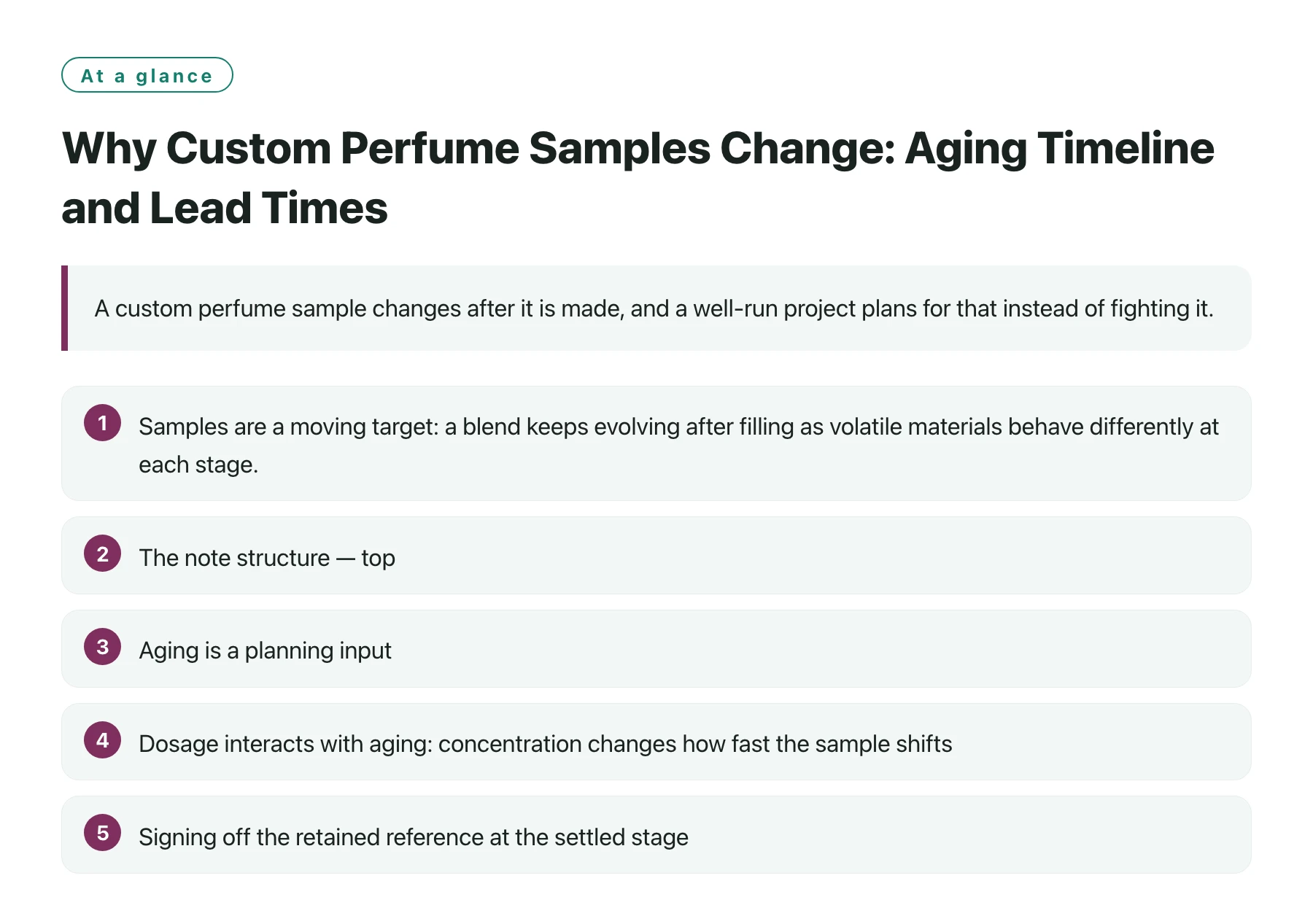
Key takeawaysSamples are a moving target: a blend keeps evolving after filling as volatile materials behave differently at each stage. · The note structure — top, heart and base — is why the change is predictable: the fastest-evaporating materials fade first while the base carries the scent [1]. · Aging is a planning input, not a defect: manufacturers routinely let concentrates and finished blends settle before release, and the schedule should say how long. · Dosage interacts with aging: concentration changes how fast the sample shifts, so the aging test should run at the final percentage. · Signing off the retained reference at the settled stage, not the fresh stage, keeps the bulk order honest.
Every fragrance project reaches the same conversation: the client says the sample smells different from the one approved last month, and the factory says it is the same formula. Both are usually right. The scent changed because perfume is a behaviour over time, not a fixed object.
The fix is not to argue about who is right; it is to put the change on the schedule. Here is what happens, when, and how to build it into your lead times.
What 'the sample changed' usually means
A fragrance is a mixture of volatile compounds that evaporate at different rates, arranged so the wearer experiences them in sequence: the top notes within minutes, the heart over hours, the base over the day [1]. Materials also interact while the blend sits, and alcohol-based concentrates go through a maturation period before they stabilise. Each of these is chemistry, not error, which is why the same formula genuinely smells different at different ages.
Individual materials have their own character and volatility, which is the kind of information documented in aroma-material references such as the Good Scents database [2]. Knowing which materials dominate the top of your blend tells you which part of the scent will shift first.
The aging timeline in practice
- Day 1–3: the fresh stageSharp top notes dominate; the blend has not melded. Never judge the final harmony here.
- Week 2–3: the maturation windowConcentrate and alcohol integrate; most of the recognisable shift happens in this window.
- Month 1–2: settlingThe scent reaches its familiar profile; this is the stage most brands actually sell.
- Month 3 onward: stabilitySlower drift continues; long-term stability data for the finished product is gathered here.
- Scale-up: the same rule appliesA bulk batch has its own settling period, so the schedule should allow it before shipping.
What to expect at each stage
| Stage | What changes | What it implies for planning |
|---|---|---|
| Fresh fill | Top notes loud, blend separate | Do not approve or reject scent decisions here |
| Two to three weeks | Materials integrate; profile firms up | Schedule the decision sample inside this window |
| One to two months | Stable, sellable profile | Retain the reference at this stage |
| Three months plus | Slow drift, oxidation in some materials | Stability data governs shelf-life claims |
| Bulk batch | Fresh batch repeats the whole curve | Allow settling time before the release date |
Use the middle row as the anchor: if the decision sample is scheduled at two to three weeks and the retained reference is signed at one to two months, most disputes disappear, because both sides are judging the same stage of the product.
Dosage and the format you sell
Concentration changes the whole timeline. A higher concentrate percentage shifts the balance towards the base and slows the visible top-note fade; a lower percentage ages faster on the shelf. That is why aging and dosage in custom perfume samples should always be tested together, at the final percentage, in the final bottle, rather than as separate experiments on paper.
For a travel or gift set the format adds a second layer: small bottles expose evaporation and closure behaviour seasonally, and the settled sample should be the one used to sign off fill and decoration, so the reference matches the product the customer opens.
The two most expensive words in fragrance development are 'it changed'. Both sides can avoid that conversation by agreeing, in writing, what stage of the sample counts as the reference — and then waiting for it.
Building aging into lead times
A realistic development schedule has four blocks: formulation rounds, settling time, decision and retention, and then bulk production with its own settling window. If the launch date assumes approval the day the sample arrives, the whole timeline is fiction.
The other practical lesson is to keep the reference chain intact. The retained sample, the batch record and the formula reference travel together, so when the bulk batch is tested against the reference, everyone is comparing the same thing. A partner that documents this chain makes the process visible: a bespoke fragrance development and production arrangement run properly is a schedule with named checkpoints, not a mood.
Finally, treat the aging window as free information. When you brief a custom development, ask the factory to put its settling practice on the schedule in writing: how long the concentrate rests, when the decision sample is judged, and when the retained reference is taken. If a manufacturer such as Xuelei lists stability and settling work as part of its development service, you can plan against that rather than around it — and the settled sample, not the fresh one, is the truthful preview of what a customer will smell months later, especially in a format as exposed as a travel set.
Sources
- Wikipedia: Perfume —— An encyclopaedic overview of perfume covering definitions, history, the note structure of a fragrance and concentration terminology (background reference only).
- The Good Scents Company —— A reference database of aroma materials with odour descriptions, CAS numbers and typical usage information.
Frequently asked questions
Why does my perfume sample smell different after a month?
Perfume is a blend of volatile materials that evaporate at different rates, so the profile shifts over time as top notes fade and the base carries the scent. A settled sample is the honest preview of the product.
How long should a sample settle before I approve it?
Two to three weeks is the practical decision window for most alcohol-based blends, with the retained reference taken at one to two months, when the profile is stable. Longer for heavier, higher-concentrate juices if the brief allows.
Does concentration change how a sample ages?
Yes. Higher concentrate percentages slow the visible top-note fade and shift the balance towards the base; lower percentages age faster. Test aging at the final dosage, not at a test percentage.
How should I build aging into my production lead time?
Add a settling block after formulation and after bulk filling. If your launch date assumes approval the day the sample arrives, extend the schedule by the settling window instead of discovering it later.
What role does the retained sample play?
It is the reference both sides test against: sealed, dated, batch-numbered and tied to the formula file. When the bulk batch is compared to it, the comparison is objective and the 'it changed' argument ends.
A 60-minute diagnostic, not a discovery call.
For $450 you leave with a written readout of where your pipeline, forecast, and process are leaking — and what to fix first. Founders and revenue leaders only.
Toronto · serving North America, the UK, the EU